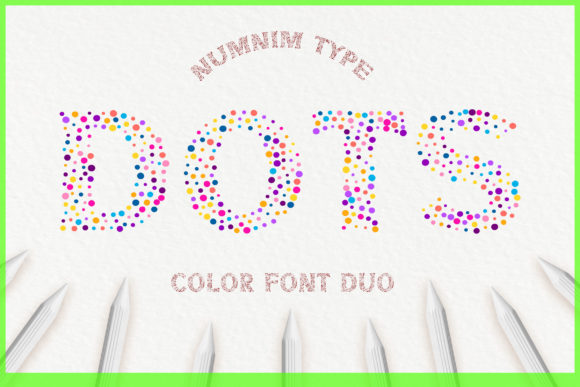
Dots: The Playful Typography Reshaping Modern Design
In a digital landscape often dominated by stark minimalism and rigid grid systems, there is a distinct shift toward warmth and personality. Enter Dots, a decorative font that challenges the status quo by constructing every character entirely from small, uniform circles. This isn't just a novelty typeface; it represents a significant evolution in how creators approach visual communication. By replacing traditional strokes with geometric clusters, Dots offers a unique texture that feels both retro-futuristic and inherently human.
The relevance of this font extends far beyond simple aesthetic preference. As professionals, entrepreneurs, and educators seek ways to stand out without sacrificing readability, Dots provides a solution that bridges the gap between playful branding and functional design. Whether you are designing a letterhead for a creative agency or crafting stationery for a local workshop, the original look of Dots appeals to a wide range of crafty ideas. It invites the viewer to engage with the text on a tactile level, even when viewed on a screen.
The Evolution of Geometric Typography
Typography has always been about more than just conveying words; it is about setting a tone. Historically, fonts have oscillated between ornate serifs and clean sans-serifs. However, the current market preference leans heavily towards designs that feel approachable and authentic. Dots fits perfectly into this shifting paradigm. While earlier geometric fonts relied on perfect lines and sharp angles, Dots introduces softness through its circular composition.
This evolution mirrors broader changes in user expectations. Modern audiences are fatigued by the sterile "corporate blue" look that pervades so many websites and documents. They crave connection. A font made of dots mimics the way we see the world up close—through pixels, points, and connections. It suggests a networked society where individual elements come together to form a cohesive whole. For freelancers and business owners, adopting a font like Dots signals that your brand is aware of these cultural nuances. It shows an understanding that design is a language, and sometimes, that language needs to be a little whimsical to be effective.
The technology behind rendering such a font has also matured. In the past, complex decorative fonts often suffered from pixelation or poor legibility at smaller sizes. Today, vector-based rendering ensures that the tiny circles that make up Dots remain crisp whether they are printed on a massive billboard or displayed on a mobile device. This technical reliability allows designers to push boundaries without worrying about the fundamental integrity of the type.
Bridging the Gap Between Digital and Physical
One of the most compelling aspects of Dots is its versatility across different mediums. The transition from digital screens to physical print remains a critical challenge for marketers and content creators. Text that looks great on a high-resolution monitor can sometimes lose its impact when transferred to paper. However, the dot-matrix structure of Dots translates exceptionally well to various printing techniques.
Consider the application of this font on stationery. When printed on textured cardstock, the gaps between the dots catch the light, creating a subtle shadow effect that adds depth to the page. This makes it ideal for wedding invitations, conference badges, or exclusive membership cards. The font naturally lends itself to embossing or foil stamping, as the circular shapes provide clear focal points for these finishing touches. For hobbyists and crafters, this opens up a world of possibilities. Imagine a DIY project where the letters are cut out using a die-cutting machine; the holes left by the dots could be filled with colorful beads or sequins, turning typography into a literal art piece.
In the corporate sector, this duality is equally valuable. A startup might use Dots for their logo to appear innovative and friendly, while using a standard serif for their legal contracts to maintain professionalism. This strategic layering of fonts demonstrates a sophisticated approach to brand identity. It allows businesses to communicate multiple messages simultaneously: we are serious about our work, but we are fun to work with.
Practical Applications for Creators and Professionals
For the diverse audience of bloggers, educators, and small business owners, implementing a font like Dots requires a thoughtful strategy. It is not a replacement for body text in long-form articles, but rather a powerful tool for emphasis and hierarchy. The key lies in knowing where to apply it to maximize impact without causing visual fatigue.
- Titles and Headlines: The primary strength of Dots is its ability to grab attention. Using it for blog post titles, YouTube thumbnails, or presentation headers immediately draws the eye. The irregularity of the dots creates a rhythm that guides the reader's gaze down the page.
- Letterheads and Branding: As mentioned, this font excels in stationary design. A business card featuring the company name in Dots stands out in a stack of plain white cards. It becomes a conversation starter, prompting people to ask about the unique design choice.
- Social Media Graphics: In the fast-scrolling environment of social media, static images need to pop. Dots works beautifully for quote graphics, event announcements, and promotional banners. The circular elements align well with the round icons and profile pictures common on platforms like Instagram and LinkedIn.
- Educational Materials: Teachers and course creators can utilize Dots to make learning materials more engaging. Worksheets, flashcards, and slide decks designed with this font can reduce the intimidation factor often associated with dense text, making the content feel more accessible to students of all ages.
However, practical implementation comes with caveats. Designers must ensure sufficient contrast between the dots and the background. Because the font relies on negative space to define the characters, low-contrast backgrounds can cause the text to disappear. Furthermore, overuse can lead to a cluttered appearance. The most successful applications treat Dots as a spotlight rather than a floodlight.
Navigating Trends Without Losing Authenticity
Trends in design move quickly, and what is popular today may feel dated tomorrow. Yet, Dots possesses a timeless quality due to its foundational geometry. Unlike fonts that rely on specific stylistic flourishes tied to a particular decade (such as the neon gradients of the 80s or the brutalist edges of the early 2000s), the circle is a universal shape. This gives Dots a longevity that few decorative fonts enjoy.
For entrepreneurs looking to future-proof their brands, choosing a typeface with this kind of structural integrity is a smart investment. It allows them to participate in current trends—like the resurgence of retro aesthetics and playful branding—without committing to a look that will expire in a year. The font adapts to the surrounding design elements, meaning it can be paired with modern photography, minimalist layouts, or even hand-drawn illustrations.
Moreover, the rise of personalized marketing means that generic templates no longer suffice. Consumers expect brands to speak directly to them in a unique voice. Dots facilitates this personalization. It breaks the monotony of standardized web forms and email newsletters. When a customer receives a digital invoice or a welcome packet styled with Dots, it feels less like a transaction and more like a curated experience. This subtle shift in perception can significantly enhance customer loyalty and brand recall.
Integrating Dots into Your Workflow
Adopting a new font is often a straightforward process, but integrating it effectively into a workflow requires planning. Most professional design software now supports custom fonts, making the installation of Dots seamless. Once installed, the real work begins in the curation of the style guide.
For teams working remotely or collaborating on projects, establishing rules for font usage is crucial. A style guide should specify exactly when Dots is appropriate and when to revert to a neutral typeface. This prevents the design from becoming chaotic. For example, a rule might state that Dots is reserved for headings under 48pt, while body text must remain in a highly legible sans-serif. Such guidelines ensure consistency across all deliverables, from internal memos to external advertisements.
Additionally, consider the accessibility implications. While Dots is visually striking, it is essential to test it for readability among users with visual impairments. High contrast modes and screen readers may interpret the dotted characters differently. Ensuring that the font does not hinder accessibility is a core tenet of ethical design. By pairing Dots with ample whitespace and clear hierarchy, designers can create experiences that are both beautiful and inclusive.
The journey of Dots from a niche decorative element to a staple in modern design libraries reflects a growing desire for creativity within professional constraints. It proves that you do not have to choose between being professional and being interesting. With careful application, this cool and fun decorative font can transform ordinary documents into memorable experiences. From the letterheads of a bustling startup to the stationery of a dedicated hobbyist, Dots offers a canvas for imagination. As we continue to navigate a world saturated with information, tools like this remind us that design still holds the power to delight, inspire, and connect us in unexpected ways.